
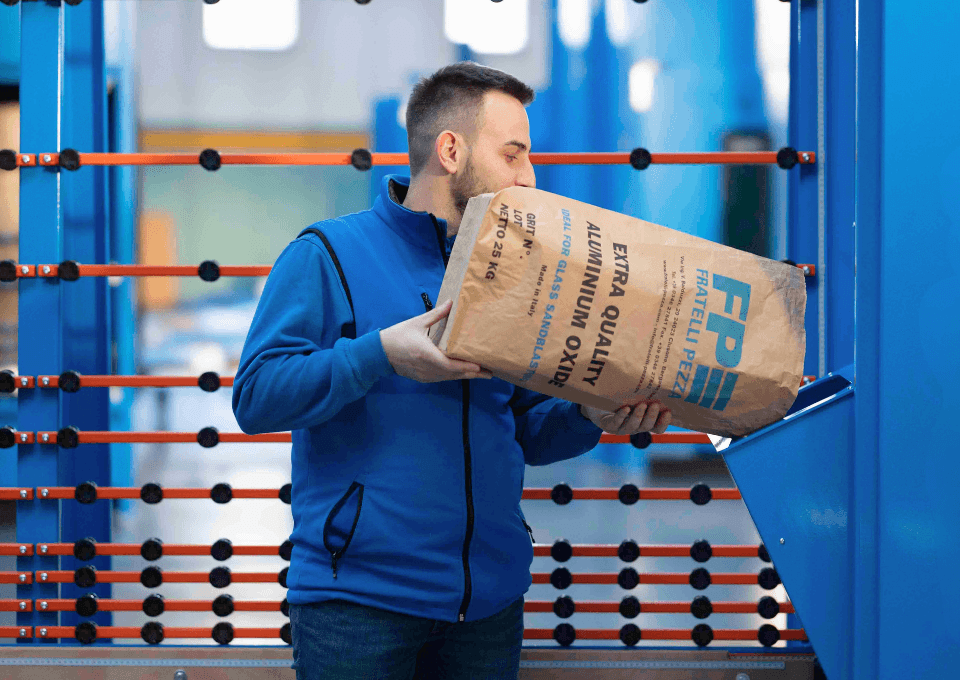
ALOX: Professional Aluminium Oxide for Glass Sandblasting
The quality of a sandblasted glass finish does not depend on the machine alone.
The abrasive plays an essential role in determining the quality of the frosted finish, processing speed, wear on sandblasting components and overall operating costs.
That’s why Fratelli Pezza has selected ALOX, a high-performance synthetic aluminium oxide abrasive specifically suited for professional glass sandblasting.
Thanks to its high hardness, angular grain structure, long service life and low dust generation, ALOX delivers consistent performance even in demanding industrial applications.
It is particularly suitable for sandblasting glass and mirrors, where uniform finishes and precise process control are essential.
At a Glance
- High-performance synthetic aluminium oxide abrasive.
- Specifically selected for professional glass sandblasting.
- Suitable for glass and mirror processing.
- High abrasive efficiency and long service life.
- Low dust generation.
- Angular grains for precise, uniform frosted finishes.
- Reusable in industrial sandblasting systems.
- Suitable for automatic and manual sandblasting machines.
- Available in grit sizes from 36 to 220.
What Is ALOX?
ALOX is a synthetic aluminium oxide abrasive selected by Fratelli Pezza for professional glass processing applications.
Its angular grain structure provides effective and controlled abrasion, making it suitable for producing uniform frosted finishes, decorative effects and precise engravings.
The material’s high mechanical strength allows the abrasive grains to retain their cutting properties over multiple operating cycles, contributing to consistent results and efficient abrasive consumption.
These characteristics make ALOX a reliable choice for glass processors working with:
- Uniform frosted glass finishes.
- Decorative glass sandblasting.
- Deep glass engraving.
- Permanent abrasive marking.
- Mirrors and decorative glass.
- Artistic glass applications.
Why Choose Aluminium Oxide for Glass Sandblasting?
Aluminium oxide is one of the most widely used abrasives in professional glass sandblasting because of its mechanical properties.
Compared with many other abrasive materials, it offers several advantages:
- High abrasive performance: its hardness and angular grain structure provide effective surface abrasion.
- Good grain stability: the abrasive retains its cutting properties over repeated use.
- Consistent finish quality: controlled abrasive characteristics help achieve uniform frosted surfaces.
- High reusability: the material can be recovered and reused in suitable industrial sandblasting systems.
- Long-term operating efficiency: extended abrasive life can help reduce material consumption and operating costs.
For glass processors, these properties are particularly important in continuous production, where consistent finishing quality and efficient use of consumables directly affect productivity.
High Abrasive Efficiency and Lower Consumption
One of ALOX’s main advantages is its resistance to wear.
During sandblasting, abrasive particles are exposed to repeated impacts. Over time, these impacts can cause the grains to break down, reducing their effectiveness.
Thanks to its mechanical strength, ALOX retains its abrasive properties over multiple operating cycles, helping reduce the frequency of abrasive replacement and replenishment.
This can provide several operational benefits:
- Lower abrasive consumption.
- Reduced operating costs.
- Greater production continuity.
- More consistent sandblasting performance.
The actual service life of the abrasive depends on operating pressure, the application, the recycling system and the machine’s working conditions.
Selecting a suitable abrasive and maintaining the correct processing parameters are therefore essential for achieving the best results.
Low Dust Generation
During sandblasting, abrasive particles gradually wear down and may generate fine dust.
The amount of dust produced depends on several factors, including abrasive quality, grain size, operating pressure and the material being processed.
ALOX is selected for its low dust generation and resistance to grain breakdown, helping maintain more stable operating conditions.
Lower dust generation offers important advantages:
- Improved visibility inside the sandblasting cabinet.
- Reduced abrasive breakdown.
- More efficient use of the filtration and recovery system.
- Greater consistency throughout the production process.
Low dust generation does not eliminate the need for suitable dust extraction, filtration and protective measures.
Correct maintenance of the sandblasting equipment remains essential for safe and efficient operation.
Why Choose an Abrasive Specifically Suited for Glass?
Not all abrasive materials are designed to achieve the same results.
Some are primarily used for metal surface preparation, coating removal or other industrial applications where the processing requirements differ from those of glass.
Professional glass sandblasting requires an abrasive capable of providing:
- Uniform frosted finishes.
- Consistent surface quality.
- Reliable processing performance.
- Controlled abrasive consumption.
- Low dust generation.
For this reason, Fratelli Pezza has selected ALOX as a professional abrasive for glass and mirror sandblasting.
Its characteristics make it suitable for applications where finishing quality, repeatability and production efficiency are particularly important.
Particularly Suitable for Mirror Sandblasting
Mirror processing requires careful control of the sandblasting process.
To obtain a uniform finish, it is important to use an abrasive with consistent characteristics and good resistance to fragmentation.
ALOX offers the abrasive performance and grain stability required for controlled mirror sandblasting applications.
This makes it particularly suitable for decorative mirror processing, where finish uniformity, engraving precision and careful control of the process are essential.
The appropriate grit size and operating parameters should always be selected according to the characteristics of the mirror and the desired result.
Main Applications
ALOX can be used for a wide range of professional glass processing applications.
| Application | Typical Use |
|---|---|
| Glass frosting | Uniform frosted finishes on glass surfaces |
| Decorative glass sandblasting | Patterns, textures and customized designs |
| Deep glass engraving | Controlled material removal for engraved effects |
| Permanent glass marking | Logos, identification codes and permanent markings |
| Mirror sandblasting | Decorative finishes and engravings on mirrors |
| Artistic glass | Customized decorative and artistic applications |
The suitability of each grit size depends on the required finish, the type of glass and the operating conditions.
Main Characteristics and Benefits
| Characteristic | Benefit |
|---|---|
| High hardness | Effective abrasive action |
| Angular grain structure | Precise, uniform surface finishing |
| High abrasive efficiency | Reduced material consumption |
| Low dust generation | More stable processing conditions |
| Good wear resistance | Longer abrasive service life |
| Reusability | Lower abrasive cost per square metre processed |
Which Aluminium Oxide Grit Size Should You Choose?
Choosing the correct aluminium oxide grit size is essential for achieving the desired sandblasted glass finish.
Grain size directly influences the appearance of the processed surface, the rate of material removal and the resulting surface roughness.
In general, the lower the grit number, the larger the abrasive particles.
Coarser grains provide a more aggressive abrasive action and are typically used when greater material removal or deeper engraving is required.
Conversely, higher grit numbers indicate finer abrasive particles, which are generally better suited to achieving delicate, uniform frosted finishes.
ALOX is available in grit sizes ranging from 36 to 220, allowing glass processors to select the most suitable abrasive for different applications.
For common glass sandblasting operations, Fratelli Pezza particularly recommends:
Grit 90: A versatile choice for general glass sandblasting, offering an effective balance between processing speed and finish quality.
Grit 180: Recommended for applications requiring a particularly fine, uniform and consistent frosted finish.
The final result also depends on blasting pressure, processing time, nozzle characteristics and other operating parameters.
ALOX Grit Size Selection Guide
| ALOX Grit Size | Finish Characteristics | Recommended Applications |
|---|---|---|
| 36–60 | Strong abrasive action and higher surface roughness | Deep engraving and specialized applications |
| 90 | Good balance between productivity and finish quality | General glass sandblasting and decoration |
| 120–150 | Uniform frosting with good definition | Decorative finishes and light frosting |
| 180 | Fine, smooth-looking and uniform frosted finish | High-quality frosted glass and refined decorative applications |
| 220 | Very fine abrasive particles | Special finishes requiring delicate frosting |
These recommendations are general guidelines. The most suitable grit should always be selected according to the application and validated through practical testing when necessary.
Which Abrasive Is Best for Glass Sandblasting?
Different abrasive materials offer different characteristics and should be selected according to the intended application.
| Abrasive | Main Characteristics | Typical Applications |
|---|---|---|
| ALOX – Aluminium Oxide | High hardness, long service life, low dust generation and good reusability | Professional glass and mirror sandblasting |
| Garnet | Natural mineral abrasive with effective cutting properties | Surface preparation and general abrasive blasting |
| White Aluminium Oxide | High-purity synthetic abrasive available in different grit sizes | Technical applications and specialized finishing |
| Glass Beads | Rounded particles producing a less aggressive abrasive action | Cleaning and selected surface-finishing applications |
White aluminium oxide is another type of aluminium oxide abrasive, generally selected for applications requiring specific purity or finishing characteristics.
Abrasives are not necessarily interchangeable. Their suitability depends on the material, equipment and desired surface finish.
How to Choose the Right Abrasive
When selecting an abrasive for glass sandblasting, several factors should be considered:
- Type of glass: float glass, mirrors or other glass materials.
- Required finish: uniform frosting, decorative textures or engraving.
- Processing depth: light surface finishing or deeper material removal.
- Production requirements: processing speed and repeatability.
- Operating costs: abrasive consumption, reusability and maintenance.
For professional flat glass processing, where finishing quality and production consistency are essential, a high-performance aluminium oxide abrasive such as ALOX is a reliable solution.
Choosing the correct grit size and processing parameters helps glass processors achieve the required finish while optimizing abrasive consumption and machine performance.
Conclusion: Abrasive Quality Makes the Difference
The abrasive is one of the key elements of a high-quality glass sandblasting process.
With its high hardness, angular grain structure, low dust generation and good reusability, ALOX provides a reliable solution for professional glass and mirror sandblasting.
Its properties help glass processors achieve consistent finishes, maintain production efficiency and control operating costs over time.
Choosing the right abrasive is not simply a matter of material selection. It is an important part of optimizing the entire sandblasting process.
Need help choosing the right ALOX grit size for your application? Contact Fratelli Pezza for technical advice on abrasives and professional glass sandblasting.
Frequently Asked Questions About ALOX Aluminium Oxide
What is ALOX?
ALOX is a synthetic aluminium oxide abrasive selected by Fratelli Pezza for professional glass and mirror sandblasting. It offers high hardness, effective abrasive performance and good resistance to wear.
Why use aluminium oxide for glass sandblasting?
Aluminium oxide provides high abrasive efficiency, consistent finishing quality and good reusability. These characteristics make it particularly suitable for professional glass sandblasting applications requiring precision and repeatability.
Why does ALOX generate less dust?
ALOX is selected for its mechanical strength and resistance to grain breakdown. These properties help limit abrasive fragmentation and dust generation during sandblasting. Actual dust levels depend on the application and operating conditions.
Can ALOX be reused?
Yes. ALOX can be recovered and reused over multiple operating cycles in suitable industrial sandblasting systems, helping reduce abrasive consumption and operating costs.
Is ALOX suitable for mirror sandblasting?
Yes. Its consistent abrasive characteristics make it particularly suitable for mirror sandblasting applications requiring precise control and uniform finishes.
Which ALOX grit sizes are available?
ALOX is available in grit sizes ranging from 36 to 220, covering different requirements from deeper engraving to fine frosted finishes.
What is the difference between grit 90 and grit 180?
Grit 90 is a versatile option for general glass sandblasting, offering a balance between processing speed and finishing quality.
Grit 180 has finer abrasive particles and is recommended for applications requiring a more delicate and uniform frosted finish.
What is the difference between ALOX and garnet?
ALOX is a synthetic aluminium oxide abrasive selected for professional glass sandblasting, offering high hardness and good reusability.
Garnet is a natural mineral abrasive used in various industrial blasting applications. The most suitable choice depends on the material, desired finish and processing conditions.